Türkiye · Amasra
Places to Visit in Amasra: Boztepe, the Kemere Bridge and the Genoese Walls
Amasra is a small coastal town whose main sights can be seen in half a day: the view from Boztepe, the Kemere Bridge, the Kilise Mosque converted from an old Byzantine church, the walls bearing Genoese coats of arms and the woodworkers' Çekiciler Bazaar. On our Safranbolu and Amasra tour you visit these stops on the third day, with an all-you-can-eat fish lunch in Amasra.
Where is Amasra and what is it like?
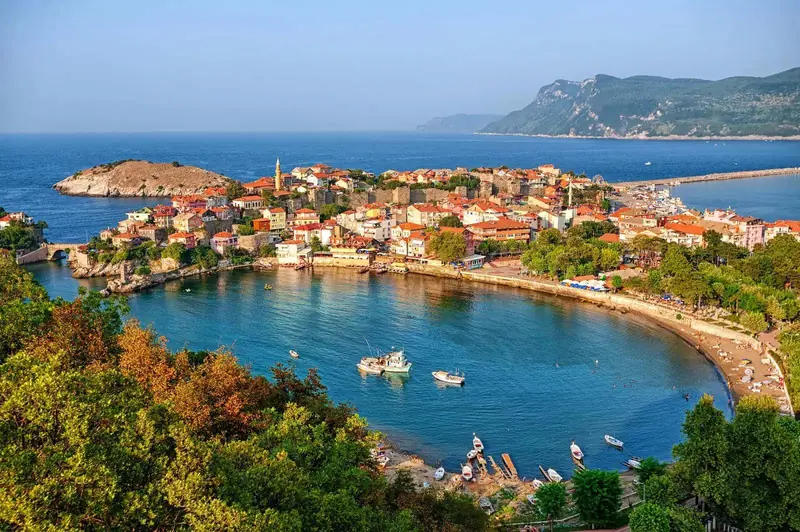
Amasra is a district in Bartın province on the western Black Sea coast. Its shape is what makes the town special: it is a peninsula settlement built between the mainland and an island close to the shore, stretching between two bays. These two bays are known as the Big Harbour and the Small Harbour. A port city for different civilisations throughout history, Amasra is today a quiet holiday town.
Boztepe
Boztepe is on the island part of Amasra and offers the best view of the town. From here you can see both harbours, the walls and the small islands in the sea at a single glance. To understand why Amasra is photographed so much, you only need to go up to Boztepe. The view is even more beautiful towards sunset.
Kemere Bridge
The Kemere Bridge is a historic stone bridge linking the main part of the town to the island where Boztepe stands. With its arch and the sea on both sides, it is a small but characterful structure. Walking across it to the island is one of the classic moments of a visit to Amasra.
Kilise Mosque
The Kilise Mosque was built as a church in the Byzantine period and converted into a mosque after the Ottomans came to Amasra. With its stonework and simple architecture, it shows the town's layered history in a single building.
The walls and Genoese coats of arms
Amasra was an important trading port that was for a time in Genoese hands in the Middle Ages. You can still see Genoese coats of arms on the walls surrounding the town today. As you wander inside the walls, looking for these coats of arms carved into the stone can become a fun game for children.
Çekiciler Bazaar
Keeping Amasra's handicraft tradition alive, the Çekiciler Bazaar is known for its woodwork. The name "çekici" comes from the craftsmen who shape wood by turning it on a lathe. In the bazaar you will find wooden spoons, bowls, salt cellars and ornaments. On our tour you have free time here.
Fish in Amasra
Amasra has kept its identity as a fishing town. The restaurants around the harbour serve fresh fish and meze spreads. On our tour, the programme includes an all-you-can-eat fish lunch in Amasra. Which fish is served depends on the season and the day's catch; on the Black Sea, autumn and winter are the more plentiful months for fish.
Alongside the fish, a local salad known as Amasra salad often comes to the table. We describe other dishes of the regional cuisine in our post on the flavours of Safranbolu and Amasra.
Suggested order for a short visit to Amasra
- Walk from the town centre into the walled area.
- See the Kilise Mosque.
- Cross the Kemere Bridge, go up to Boztepe and take in the view.
- On the way back, stroll through the Çekiciler Bazaar.
- Round off the day with a fish meal around the harbour.
On our tour, the order is set by the guide according to the flow of the day, but the stops are the same.
Amasra with children
Thanks to its small scale, Amasra is an easy town to explore with children. Looking for Genoese coats of arms on the walls, crossing the Kemere Bridge to walk to the island and watching the fishing boats in the harbour keep children interested. Hold children's hands at points near the edge on Boztepe; some sections may have no railings. At the all-you-can-eat fish lunch, remember to help children with the bones.
A brief look at the history
Amasra's history goes back to antiquity. The town has been the port city of different civilisations in different periods. It was an important coastal settlement in the Byzantine period; in the Middle Ages, the Genoese used it as a base for Black Sea trade. It then became part of the Ottoman lands. Today the walls, the church building and the coats of arms make this layered past visible in the town's streets.
Photo spots
Capturing both harbours in one frame from Boztepe, photographing the Kemere Bridge with its arch from the shore and taking close-ups of the coats of arms on the walls are Amasra's classic shots. Around the harbour, the fishing boats also make a colourful foreground.
When to go
In summer Amasra takes on the air of a seaside holiday town and the crowds grow. Spring and autumn are pleasant for a visit, with quieter streets and weather suited to walking. In winter the town goes quiet; the sea is rough and the scenery dramatic. As it is on the Black Sea coast, be prepared for rain in every season.
After Amasra
On our tour, after Amasra you travel via Çaycuma to Devrek and visit a workshop where the famous Devrek walking sticks are made. The return to Istanbul is via Mengen, Yeniçağ and Bolu.
Practical notes
- The climb up Boztepe is short but steep. Wear comfortable shoes.
- The wind often blows on the coast. Even in summer a light windbreaker is useful.
- Wooden handicrafts are light and unbreakable, so they are easy to carry home as gifts.
Frequently asked questions
How much time do you need to see Amasra?
The town's main sights can be seen in a few hours. On our tour, Amasra is a stop covering the midday hours of the third day.
Which province is Amasra in?
Amasra is a district of Bartın province. On our tour you travel via Bartın to Amasra.
Is the fish lunch in Amasra included in the tour?
Yes. The programme includes an all-you-can-eat fish lunch in Amasra.
What is the Kemere Bridge?
It is the historic stone bridge linking the main part of the town to the island where Boztepe stands.