International · Mtskheta
Mtskheta Guide: Jvari and Svetitskhoveli in Georgia's Old Capital
Mtskheta is a small historic town just north of Tbilisi, known as Georgia's old capital and the place where the country adopted Christianity. There are two main buildings to see here: Jvari Monastery, looking down from a hill onto the point where two rivers meet, and Svetitskhoveli Cathedral in the town centre. Both are part of the Historical Monuments of Mtskheta on the UNESCO World Heritage List.
Why is Mtskheta important?
For centuries Mtskheta was the capital of the ancient kingdom of Kartli (Iberia). According to Georgian tradition, in the 4th century the kingdom adopted Christianity under the influence of Saint Nino, and this took place in Mtskheta. Although the capital later moved to Tbilisi, the town kept its importance as a holy centre of the Georgian Orthodox Church. It is still a place where important religious ceremonies are held today.
The town stands where the Aragvi and Kura (Mtkvari) rivers meet. This location was strategically important in history and today makes Mtskheta very photogenic.
Jvari Monastery: the cross on the hill
Standing on the hill opposite the town, Jvari Monastery is a 6th-century church. Its name means "cross" in Georgian. Tradition has it that Saint Nino erected a large wooden cross here, and the church was later built over this holy site.
Jvari's architecture served as a model for many later Georgian churches. The building is plain and made of stone, with a simple atmosphere inside. But the real experience here is outside: looking down from the terrace beside the church, you can see the point where the lighter waters of the Aragvi meet the darker waters of the Kura, with the whole town of Mtskheta below. This view is one of the most memorable images of a trip to Georgia.
The wind can be strong on the hilltop; in spring and autumn a cardigan or windbreaker will come in handy.
Svetitskhoveli Cathedral: the heart of the town
Svetitskhoveli Cathedral, in the town centre, is one of Georgia's most important churches. The present building dates from the 11th century and rises in the middle of a courtyard enclosed by high walls.
Its name means "living pillar" and is based on a legend. Tradition tells that the robe (tunic) of Jesus was brought to this region and buried on the site of the cathedral, and that a pillar made from a tree that grew here showed miraculous properties. This story makes the cathedral a very special place for Georgians.
Inside are frescoes, stone carvings and the tombs of Georgian kings. The cathedral is still an active place of worship; you need to keep quiet during services and be careful when taking photos.
The town's streets
The short, restored streets around Svetitskhoveli are lined with cafés and shops selling souvenirs and local products. Churchkhela, the Georgian sweet (strings of walnuts or hazelnuts dipped in grape must and dried), and local wines are widely sold here. It is a good place for a short shopping stop.
Visiting rules
Both buildings in Mtskheta are active churches. In Georgian Orthodox churches, the following rules generally apply:
- Women are expected to cover their heads and to wear a skirt or a skirt-like wrap. Wraps are often available at the entrance, but bringing your own is practical.
- It is appropriate for men to wear long trousers rather than shorts and to remove their hats in church.
- Avoid clothes that leave your shoulders bare.
- Keep quiet during services and pay attention to signs around you before taking photos.
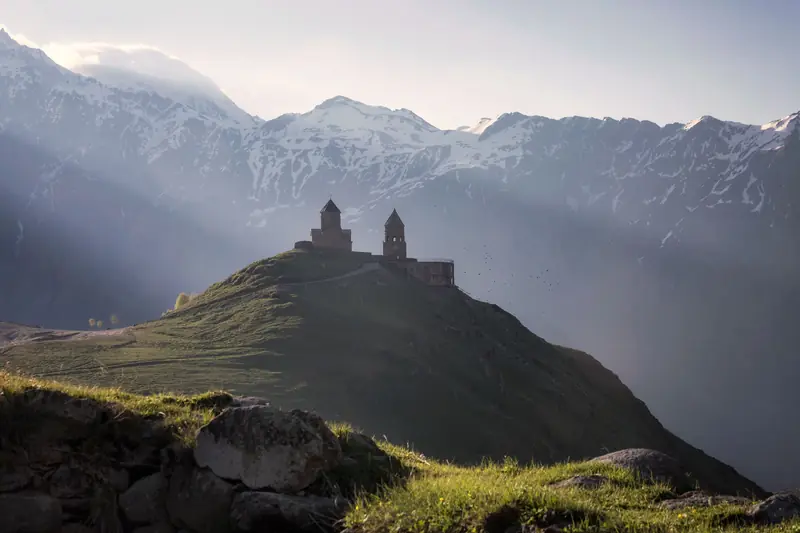
These rules also apply to Gergeti Trinity Church in Kazbegi; for that day, simply bring a wrap and suitable clothing.
How Mtskheta fits into the tour
The Georgia Tour: Tbilisi, Mtskheta and Kazbegi is a 3 nights, 4 days programme with hotel accommodation. On the morning of day two you visit Jvari Monastery and Svetitskhoveli Cathedral in Mtskheta. Then you head up the Georgian Military Road to Gudauri and Kazbegi and see Gergeti Trinity Church, returning to Tbilisi in the evening. This tour is a new programme not in the catalogue.
For the mountain part of the day, see our guide to Kazbegi and the Georgian Military Road, and for sights in the capital, our article on places to visit in Tbilisi.
How to make the most of your time in Mtskheta
Arriving in the town early in the morning usually makes for a calmer visit; crowds can grow at weekends and on religious holidays. Even when it is overcast, you can see the confluence of the two rivers from Jvari's terrace.
Mtskheta is a small town, and its two main buildings are at the heart of the programme. Giving time to the view at Jvari and to the interior and courtyard at Svetitskhoveli keeps the visit balanced. Do not forget to take a close look at the stone reliefs on the exterior of Svetitskhoveli; here you can see fine examples of Georgian stonework. The walls around the cathedral offer angles from which you can see the whole building from a distance. Before leaving the town, a short coffee or churchkhela stop is good preparation for the mountain journey later in the day. After Mtskheta the road starts climbing north into the mountains; do not forget to bring an extra layer.
Frequently asked questions
How far is Mtskheta from Tbilisi?
Mtskheta is just north of Tbilisi and can be reached by a short drive. That is why it is usually visited as the first stop on the road to Kazbegi.
Why is Jvari Monastery famous?
Dating from the 6th century, this church served as a model for later Georgian church architecture. It is also famous for its view over the confluence of the Aragvi and Kura rivers and over Mtskheta.
What does Svetitskhoveli mean?
It means "living pillar" in Georgian. The name is based on a legend that the robe of Jesus was buried on the site of the cathedral and that a pillar made from the tree that grew there was miraculous.
Is a headscarf required to enter the churches in Mtskheta?
In Georgian Orthodox churches, women are expected to cover their heads. Scarves are usually available at the entrance, but it is more practical to carry your own.